Materials
What natural fibre actually does
1. The six fibres
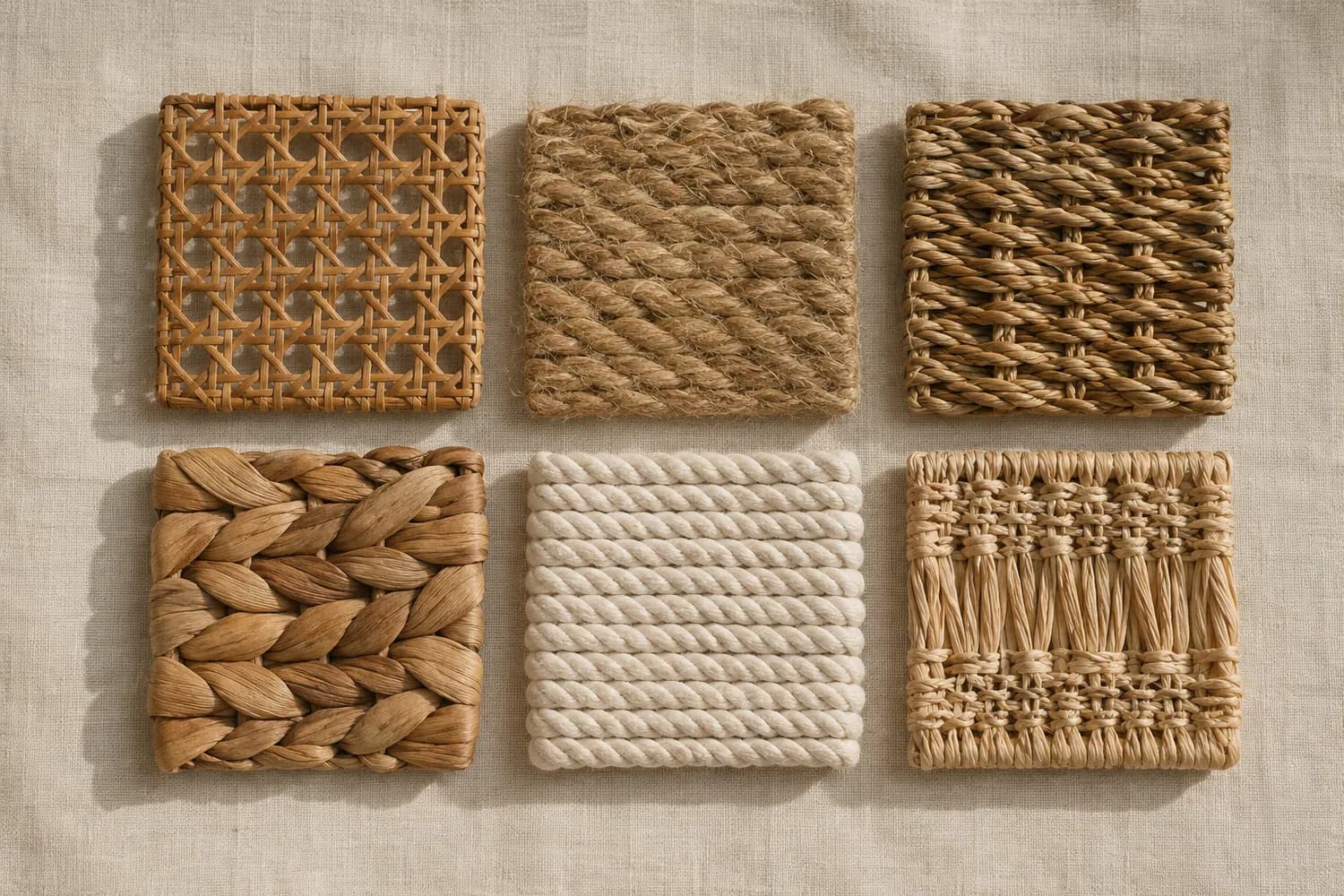
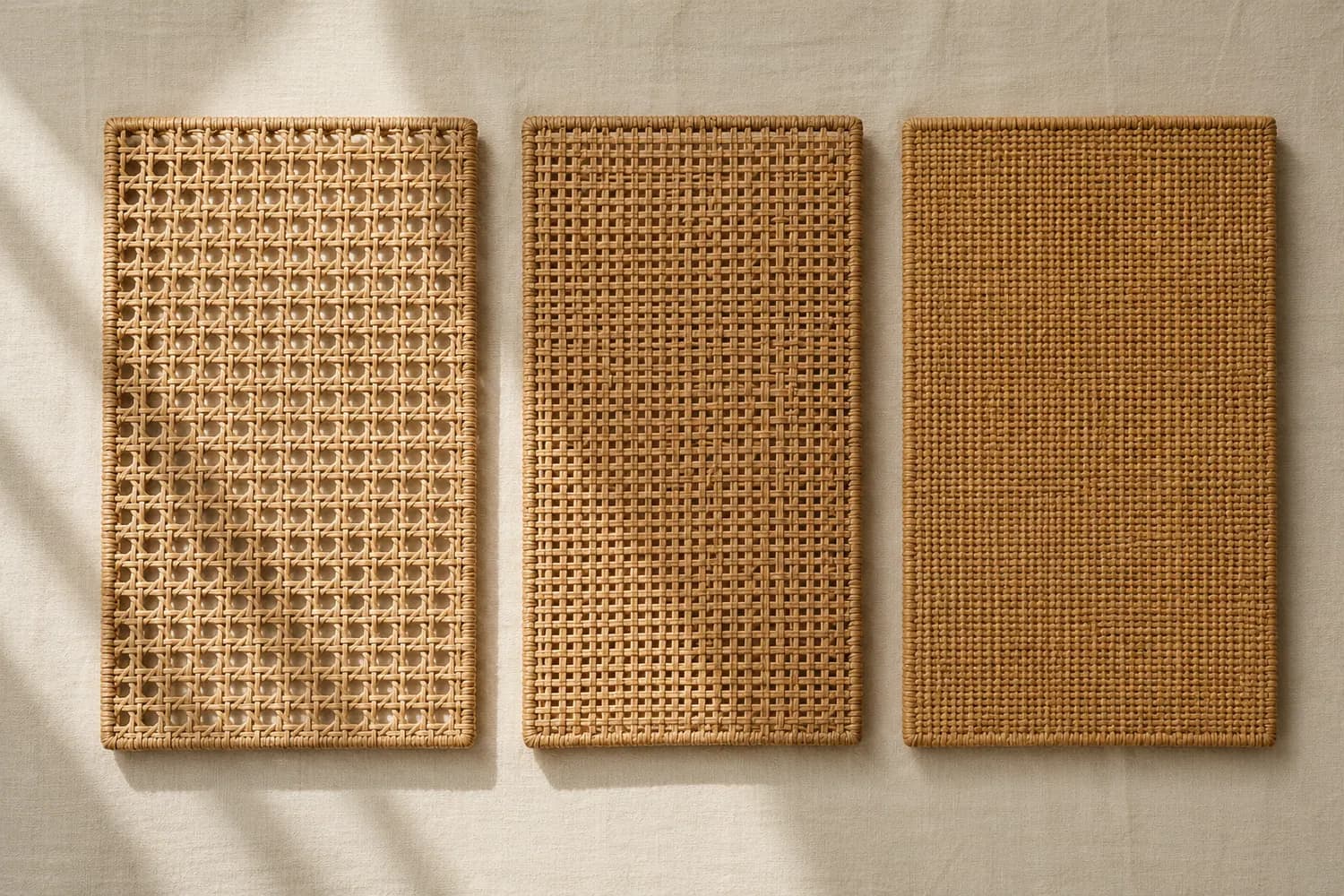
Rattan
Calamus rotang
4 pieces · woven in Indonesia
- Character
- Peeled cane from a climbing palm. The stiffest thing we work with, and the only one that keeps a shape on its own without a frame.
- Strength
- Highest. Our 12 kg firewood basket is rattan, and it is the only fibre we would put logs in.
- Damp rooms
- Tolerates a damp room better than most, provided it can dry. It still must not sit wet.
- Watch out for
- Cane can split at a sharp bend if the piece is forced. It does not shed, but a split cane end is sharp — trim it flush.
- Cleaning
- Brush the weave out with a dry soft brush, then wipe with a barely damp cloth and dry at once. Not washable, not machine washable.
- Smell when new
- Almost none. A faint woody smell may be noticeable in the first few days.
Jute
Corchorus olitorius
11 pieces · woven in Bangladesh
- Character
- Spun and twisted plant rope, soft and thick. It gives a chunky, obviously handmade weave with a lot of surface.
- Strength
- High for its weight. Our 10 kg blanket basket is jute.
- Damp rooms
- Poor. Jute absorbs moisture readily and holds it. Dry rooms only.
- Watch out for
- This is the fibre that sheds. Expect visible fibre dust for the first month, more if the piece is moved often, and never quite nothing after that.
- Cleaning
- Vacuum on low suction or brush the dust out, then spot-clean with a barely damp cloth and dry at once. Not washable, not machine washable.
- Smell when new
- A dry sacking smell for the first one to two weeks. It fades with airing.
Seagrass
Cyperus malaccensis
20 pieces · woven in Vietnam
- Character
- Flat dried blades, coiled in tight rows. Smooth to the hand, faintly green when new, warming to hay over a year or two.
- Strength
- Good. Most of our storage and laundry range is seagrass at 4 to 8 kg.
- Damp rooms
- The best of the soft fibres for damp rooms, as long as air can move through the weave and around the piece.
- Watch out for
- Sheds lightly at first. The green tone fades noticeably in direct sunlight — keep it out of a south-facing window if you want it to stay green.
- Cleaning
- Dust with a soft brush, then wipe with a barely damp cloth and dry at once. Not washable, not machine washable.
- Smell when new
- A grassy, hay-like smell for the first one to two weeks. Air it in a dry, ventilated room.
Water hyacinth
Eichhornia crassipes
6 pieces · woven in Indonesia
- Character
- Wide flattened straps braided into a broad plait. Deep tobacco brown, with visible creases where the strap was folded.
- Strength
- High. Our largest floor baskets are water hyacinth at 10 kg.
- Damp rooms
- Good, with ventilation. The broad plait dries faster than a tight coil.
- Watch out for
- The straps vary in width within a single piece — that is how the plant grows, not a flaw. Shade varies more between batches than any other fibre we use.
- Cleaning
- Brush the dust out of the plait, then wipe with a barely damp cloth and dry at once. Not washable, not machine washable.
- Smell when new
- An earthy, faintly sweet smell for the first two to three weeks.
Cotton rope
Gossypium herbaceum
5 pieces · woven in India
- Character
- Twisted undyed rope, knotted rather than woven. Soft, pale, and the only fibre here that is comfortable against skin.
- Strength
- Low in tension for its bulk. We use it for macrame and for hanging cords, not for load-bearing baskets.
- Damp rooms
- Poor. Cotton holds moisture and will mildew in a damp room.
- Watch out for
- Cords and fringes are a strangulation risk near children. Every corded piece we sell carries that notice and is excluded from Fit Finder results for a child's room.
- Cleaning
- Spot-clean with cold water and a mild soap, reshape while damp and dry flat. Not machine washable.
- Smell when new
- None.
Raffia
Raphia farinifera
6 pieces · woven in Madagascar
- Character
- Fine flat ribbons from a palm leaf. The finest weave we can make — close enough that a thin chain will not work through it.
- Strength
- Low. Trays and small organisers only, up to about 2 kg.
- Damp rooms
- Poor. Raffia takes up water and goes limp, then dries stiff and brittle.
- Watch out for
- Never wet raffia, not even to clean it. Dry brush only.
- Cleaning
- Dust with a dry soft brush only. Do not wet it. Not washable, not machine washable.
- Smell when new
- A light straw smell for the first week.
2. Batch variation: ±10 % shade, ±5 % size
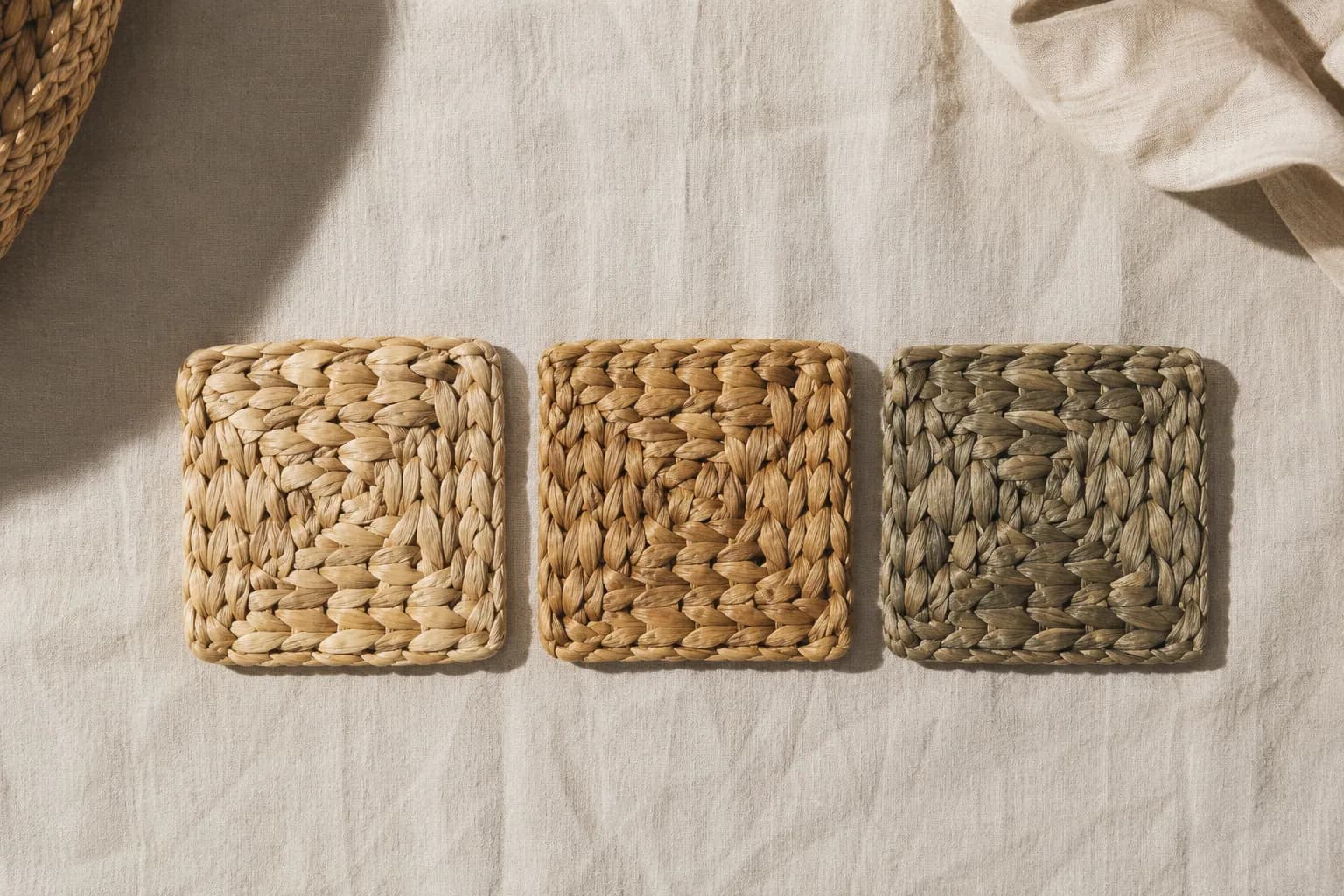
The three squares in this photograph are the same product, the same weave and the same supplier — three different harvests. This is the honest range you should expect.
Plant fibre takes its colour from where it grew, when it was cut and how it was dried. We publish a tolerance of ±10 % in shade and ±5 % on every dimension, and we hold ourselves to it.
What that means in practice: pieces bought together are matched, because we pull them from one batch. Pieces bought months apart are not. If you want a matched group, buy them at the same time, or buy one of the sets — those are woven in a single batch for exactly this reason.
Shade variation within the published tolerance is not a defect and is not grounds for a complaint. It is, of course, a perfectly good reason to use the 14-day right of withdrawal if you do not like what arrived.
3. Shedding, and what the grades mean
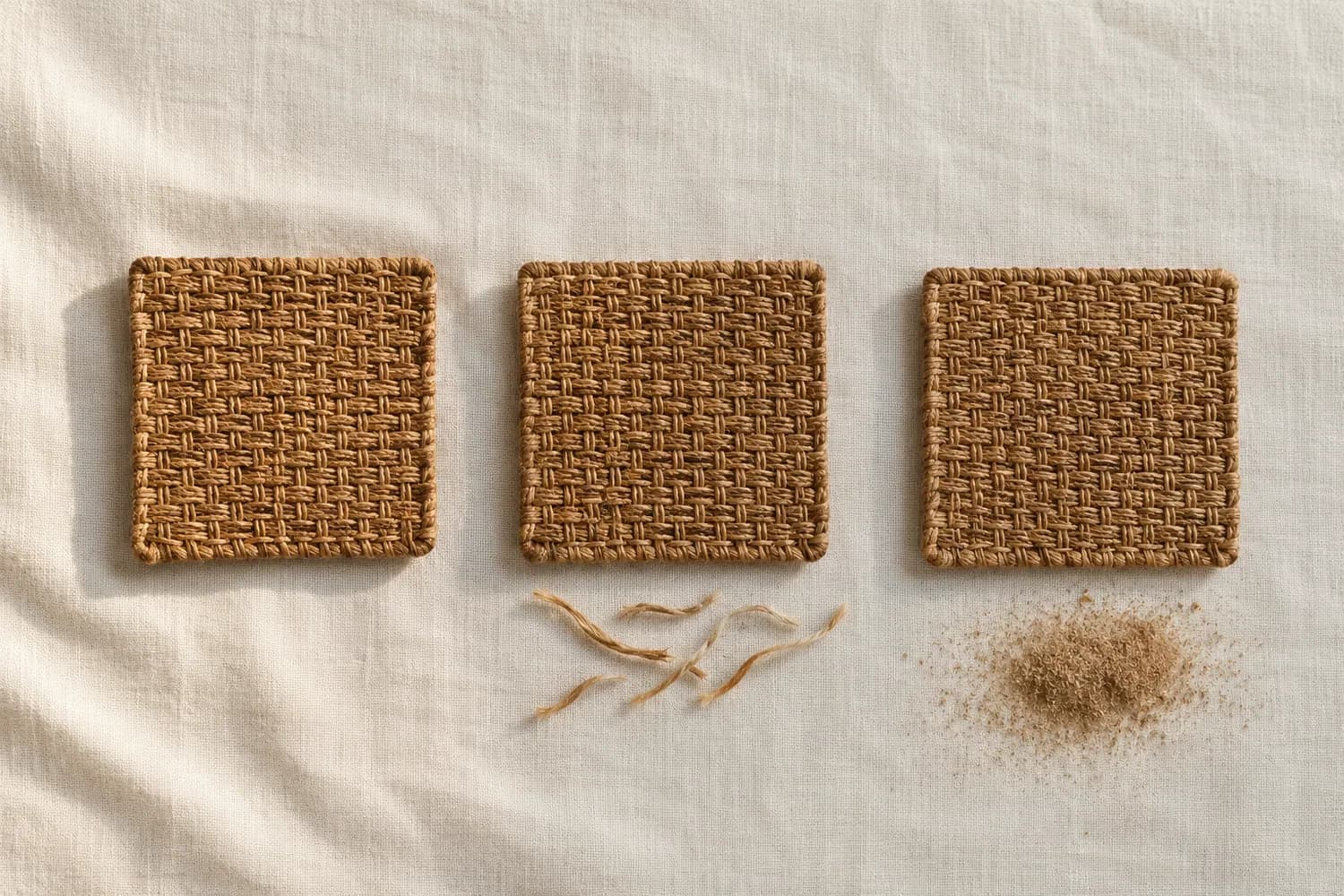
Every product page carries one of three grades:
| Grade | What you will see | What to do |
|---|---|---|
| None measured | No loose fibre came off during our first month of handling. Rattan behaves this way. | Nothing. |
| Light | A little fine fibre for two to four weeks, mostly when the piece is first moved or filled. Seagrass, water hyacinth, raffia and cotton. | Vacuum around it for the first fortnight. Shake it out over a bin once a week until it stops. |
| Yes | Visible fibre dust for a month or more, and never quite zero afterwards. This is jute. | Do not put a jute basket on a dark carpet you care about. Vacuum under it weekly for the first month. If it holds textiles, expect a little fibre on them. |
Shedding is the fibre releasing the short ends left over from spinning and weaving. It reduces sharply and then settles at a low level. We do not sell anything that stops shedding entirely, and we will not describe anything as shed-free.
4. Smell when new
Dried plant matter smells of dried plant matter. Seagrass smells grassy, like hay. Jute smells of dry sacking. Water hyacinth smells earthy and slightly sweet, and is the strongest of the three. Rattan is nearly odourless and cotton has no smell at all.
It fades in one to three weeks. To speed it up: unpack the piece and leave it unwrapped in a dry ventilated room, out of direct sun, for a few days before you use it. Do not try to wash the smell out — wetting these fibres makes it worse, not better, and may cause mould.
5. Shape change under load
Fibre is not rigid. Load a basket and the base flattens slightly, the walls bow outward and the rim goes a little oval. Our bench notes give the actual measured movement for each piece — usually 2 to 6 mm.
What comes back: most of it, if you empty the piece and leave it a day or two. Fibre relaxes.
What does not: shape taken while the fibre was damp; shape taken above the published load; a piece stored crushed under something heavy; a bend sharp enough to break the strands on the outside of the curve. Those are permanent, and they are the reason our load figures are published with the condition attached.
We do not claim that any piece keeps its shape indefinitely, and we will not describe anything as non-deforming.
6. Damp rooms, and mould
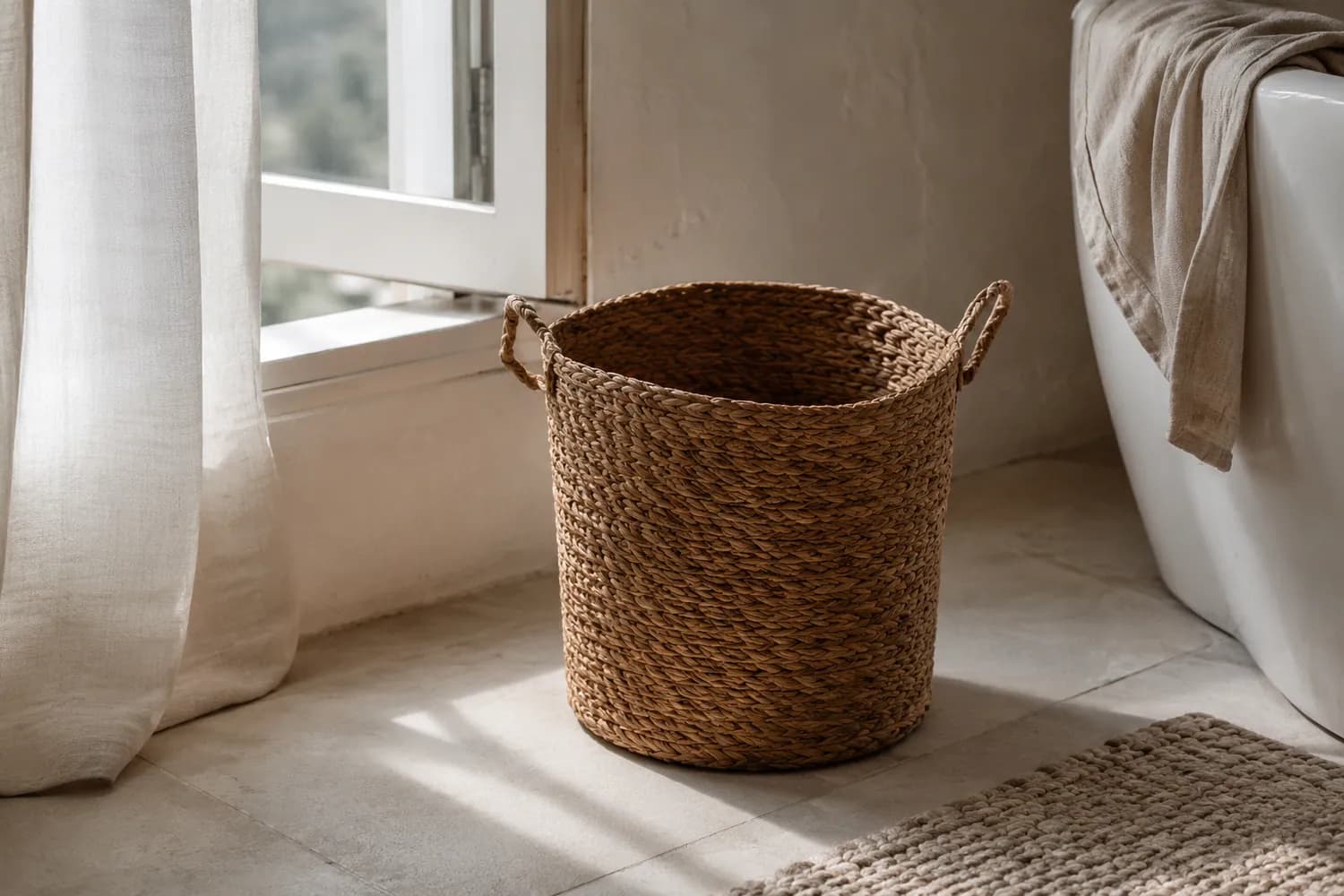
Natural fibre is organic. Kept damp, it will eventually grow mould. There is no treatment on anything we sell that changes this, and we make no mould-proof, mildew-proof or antibacterial claim for any product. Claims like those would fall under biocidal product rules, and we hold no such approval.
What we do instead is tell you which pieces we have rated for damp rooms, and on what condition:
- The room must have an extractor fan or a window that gets opened. A sealed bathroom is not a damp room, it is a wet one.
- The piece must not sit in direct shower spray.
- It must be able to dry between uses. An open weave dries fastest, which is why the bathroom basket is deliberately woven loose.
- Never put damp textiles into a basket and close the lid on them.
If a piece does start to smell musty, get it out of the room, brush it off dry, and let it dry fully in moving air. Once mould has taken hold in the fibre it does not come out.
7. Cleaning: most of this cannot be washed
Nothing we sell is machine washable except the removable cotton liner supplied with the Laundry Basket with Liner, which takes 30 °C. Nothing else goes in a machine, a sink or a bucket.
- Routine: dry soft brush, or a vacuum on low suction with a brush head. Work along the weave, not across it.
- Marks: a barely damp cloth on the spot only, then dry it at once with a dry cloth and leave it in moving air.
- Never: soaking, running water, detergent, bleach, steam, a dishwasher, or a washing machine. Raffia must not be wetted at all.
- Cotton rope pieces: spot-clean with cold water and mild soap, reshape while damp, dry flat.
8. It burns
Dried plant fibre is flammable, and an open weave has a lot of surface area. Keep every piece away from candles, hobs, heaters, fireplaces and hot appliances. Do not use a basket to carry ash or embers, and do not put a power supply that runs warm inside a closed basket.
Nothing we sell is flame retardant and we make no flame-retardancy or fire-resistance claim.
9. What we will not say
A short list, so you can hold us to it. Nowhere on this site will you find us claiming that a product:
- never warps, never fades or never sheds;
- has an unlimited or unstated load capacity;
- resists mould, mildew or bacteria;
- is washable or machine washable, where it is not;
- is food-safe or suitable for direct contact with unwrapped food;
- is sustainable or environmentally friendly — we hold no certification for that;
- is made in Denmark. Design is Danish; weaving happens in Vietnam, Indonesia, Bangladesh, India and Madagascar, and every product page names the country;
- is handwoven, where it was not.
If you find wording anywhere on this site that crosses one of those lines, tell us at support@studiohafnia.mom and we will correct it.
10. Not for food
Nothing in this shop is a food container. Some of it looks like tableware — bread baskets, fruit bowl baskets, placemats, runners, coasters, bottle baskets, cutlery caddies — and each of those carries a notice on its own page: use it with packaged goods, or with a cloth or liner in between, never in direct contact with unwrapped food. We hold no food-contact declarations of conformity and we make no food-contact claim.